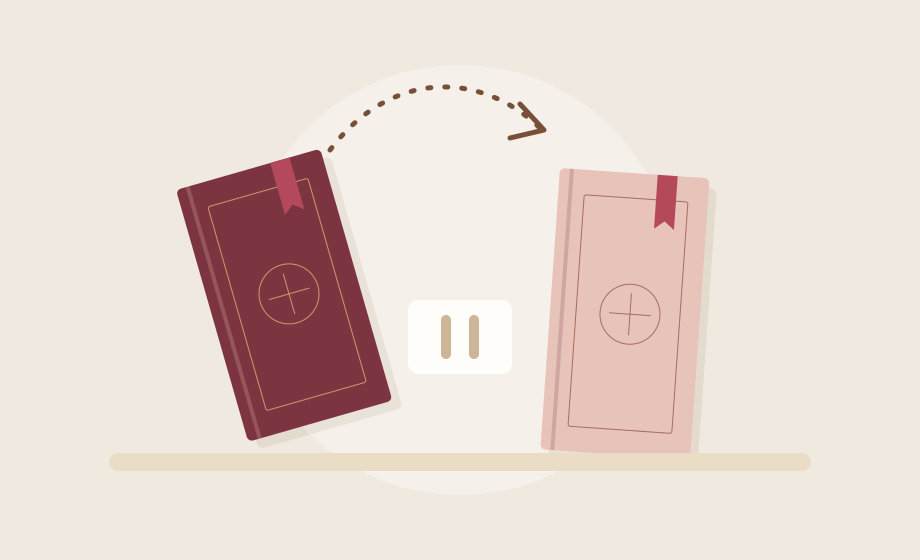
A reading habit starts with three decisions: which book you’ll open, when you’ll open it, and how many pages count as enough on an ordinary day. You don’t need a perfect morning routine or a list of fifty titles for the year. One book you actually want to read, a regular moment and a goal small enough for a bad Tuesday will do.
Below is a plan for your first week. Treat it as an experiment: see what works and change one thing at a time.
The book
The one you want to open tonight. Ambition can wait.
The moment
A specific point in your day you already have: coffee, commute, bed.
The minimum
Five pages or one short chapter. More only when the story pulls you in.
Pick a book you want to open
At the start, it doesn’t matter whether the title is impressive. It matters whether you want to open it tonight. A short novel, a piece of reportage, a comic or a fantasy doorstopper all make a good start. If a book bores you after fifty pages, put it down and pick another. A habit grows from reading. Nobody requires you to finish everything you’ve ever started.
Attach reading to something you already do
“I’ll find the time” rarely works. A specific moment works better because it removes a decision. Good anchors include:
- tea or coffee after breakfast,
- your commute,
- the first ten minutes after you get into bed.
If-then plans work in a similar way: research on implementation intentions shows that tying a behaviour to a specific situation helps people get started.
Choose one and write it as a single sentence: “After dinner I read before I pick up my phone.” If you fall asleep over the book every evening, move reading to another time of day. There’s no point fighting your own tiredness.
Set a minimum for an ordinary day
A good minimum feels slightly too small. Five pages or one short chapter is enough to get started. If the story pulls you in, keep going. If it doesn’t, five pages still count.
Write down a separate version for a calmer day: “Five pages on weekdays, longer on Sunday if I feel like it.” That way one great weekend doesn’t raise the bar for the whole next week. For help matching the number to your day, see how many pages a day to read.
Remove one obstacle
Ask what usually stops you before the first page. Is the book in another room? Can’t remember where you stopped? Do you always check messages first?
Pick one fix: put the book next to your mug, slide the bookmark in as soon as you finish, leave your phone in another room. You don’t need a new armchair or a special lamp. If your phone is what usually beats the book, see how to focus while reading.
Write down just enough to find your way back
After reading, note the page number. In a few days you’ll see whether the book is really moving, and you’ll know where to pick it up. Add quotes, ratings and chapter notes only if you enjoy it.
In Talemi you add a book to your shelf and save your current page, and the app shows your book’s progress and the pages you read this week. If you’d rather start with a scrap of paper, that works too. More simple ways to keep track are in how to track reading progress.
What if you miss a day or a whole week?
Return to the small minimum at the next good moment. Don’t add a debt like “tomorrow I’ll read three times as much.” A day off breaks nothing, and your shelf isn’t going anywhere. If you know a hard week is coming, lower the goal or take a deliberate break. In a study of everyday behaviours, the time to reach automaticity ranged from 18 to 254 days, and missing a single day did not derail the process. That is a good reason not to punish yourself for a gap. That is how the reading streak in Talemi works too: a few pages keep the day, and a break doesn’t erase your history.
After a longer pause, reread the last page you read or your own note. If you no longer want to go back to that story, choose another one.
Your first-week plan
- Day 1. Choose a book, a moment and a minimum. Write them down in one sentence.
- Days 2 to 6. Read your minimum, then note the page. Check only two things: did you manage to start, and was the moment convenient?
- Day 7. Ask yourself when reading felt easiest and what got in the way. Change one thing for next week.
After a week you have a first point of reference and a few more pages than before. If you’d like your books, progress and friends in one place, see how Talemi works and join early access.
FAQ
How long does it take to build a reading habit? It depends on the person. In the study we cite above, the time to automaticity ranged from 18 to 254 days.
Should I read in the morning or evening? Whenever it is easier to start. After day seven, check which time worked best.
What if I have no time? Keep the five pages. If even that is too much, lower the goal but keep the time of day.
Do audiobooks count? Yes, if you decide so. Then count minutes instead of pages.
How do I turn a yearly goal into pages a day? Divide the pages you want to read by the days left, or let the reading goal calculator do it for you.
Keep reading
- How to read more books: 7 changes that work
- How to get back into reading: a 7-day plan
- Reading before bed: how to turn it into a ritual
- How many pages a day to read?
Sources
- Gollwitzer, P. M. (1999). Implementation intentions: Strong effects of simple plans. American Psychologist, 54(7), 493–503.
- Lally, P., van Jaarsveld, C. H. M., Potts, H. W. W., Wardle, J. (2010). How are habits formed: Modelling habit formation in the real world. European Journal of Social Psychology, 40(6), 998–1009.